
The Home Binder: The Most Important Book You'll Hopefully Never Need
There is a particular kind o relief that comes from opening a well-organized binder.
Not excitement. Not pride, exactly.
Relief.
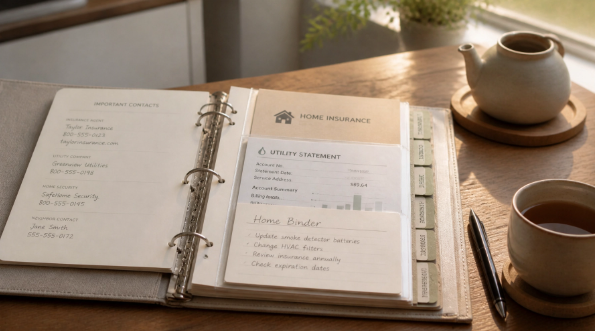
The binder sits on a shelf near the front hall, tucked out of casual view but easy to reach. Its pages are divided by simple tabs. A pen rests in the inside pocket. The information is current. The instructions are clear.
You know where to find the insurance policy.
You know which number to call if the power goes out, the roof begins to leak, or a medical question cannot wait until morning. You know where the important documents are kept, and you have written down enough for someone you trust to help if you cannot explain everything yourself.
The house feels a little steadier because of it.
This is the quiet purpose of a home binder. It is not a collection of frightening possibilities. It is a physical map of the life you have built.
A Small Book of the Life You’re Living
Most households have important information scattered across several places.
A folder in a desk drawer. A password manager on a phone. A stack of insurance papers in a kitchen cabinet. A doctor’s number saved under a first name. A utility account that exists only in an email inbox.
Ordinarily, this arrangement may be sufficient.
But when the usual systems are unavailable, or when someone else needs to help, the scattered pieces become difficult to assemble. A home binder brings them together in one calm, understandable place.
It is part filing system, part instruction manual, and part act of consideration.
The goal is not to record your entire life. The goal is to make the important parts easy to find.
As we explore throughout the Aging Solo collection, independence is not the absence of support. It is the ability to make thoughtful choices about how support can work when it is needed.
A home binder is one piece of that quiet infrastructure.
Quiet infrastructure rarely announces itself. Its value appears the moment life becomes unexpectedly complicated.
> A home binder is not a book about what might go wrong. It is a map for helping life continue well.
What Belongs Inside
Choose a sturdy three-ring binder with durable dividers. A neutral color is useful; there is no need to label it in a way that announces its contents.
You may want to place it inside a document box, protective sleeve, or small fire-resistant container. Keep original documents in their proper secure location: a safe, safe-deposit box, or other place appropriate to the document. The binder can hold copies and concise summaries.
The sections might include:
Household and personal information
Include the basic facts someone would need to identify and reach the people in your household:
Full names and preferred names
Dates of birth
Current addresses
Copies of identification cards, where appropriate
Emergency contacts, including one person who lives outside your immediate area
Information about pets, including veterinary contact details and vaccination records
This section is especially helpful when a trusted person is assisting from outside the home. It reduces the need to search through drawers, email accounts, or old calendars for information that should be easy to find.
Medical information
A concise medical summary can be more useful than a thick stack of records.
Consider including:
Current medications, dosages, and prescribing clinicians
Allergies and significant medical conditions
Health insurance information
Primary care and specialist contact details
Pharmacy name, address, and phone number
Copies or locations of relevant medical directives and authorization forms
Keep this information current. A medication list from two years ago is not a reliable guide.
You do not need to include every medical document you have ever received. Focus on the information that would help a trusted person communicate accurately with medical professionals or manage an urgent practical need.
Insurance and financial information
This section should help someone understand what exists and who to contact.
Include summaries or copies of:
Homeowners or renters insurance
Auto insurance
Health, life, disability, or long-term care insurance
Mortgage or lease information
Bank and investment institution names
Recurring bills and automatic payments
Tax preparer or financial professional contact details
Use your judgment about how much detail belongs here. An institution's name, customer service number, and a note about where secure access is kept are often enough.
The Emergency Financial First Aid Toolkit from Ready.gov offers another useful framework for thinking about the financial records a household may need to gather.
Home, vehicle, and utility information
A home binder should also explain the practical workings of the household.
You might include:
Utility providers and account numbers
Internet and mobile service information
Heating and cooling service contacts
Plumber, electrician, or other trusted repair contacts
Home warranty details
Vehicle registration and insurance information
Locations of shutoff valves, circuit breakers, and spare keys
Instructions for operating a security system, smart lock, or thermostat
This is where the binder becomes more than a document folder. It becomes a household manual.
A person standing in your kitchen should not have to guess which valve shuts off the water or search through old messages to find the name of the person who repaired the furnace.
Legal and personal instructions
Copies of wills, powers of attorney, health care directives, and related documents may belong in the binder, while originals remain securely stored according to your attorney’s or institution’s guidance.
You can also include a simple page titled “Things to Know.”
This might contain:
Who should be contacted first
Where original documents are stored
How to reach your attorney, financial professional, or insurance agent
What arrangements exist for pets
Any household routines that would help another person step in
Where a trusted person can find your secure digital records
The instructions do not need to be elaborate. Clear is better than comprehensive.
Every household is different. The goal isn't to create the perfect binder in one afternoon. It's to make tomorrow a little easier than yesterday.
Where Digital Life Meets the Physical Page
The home binder is not a rejection of technology. It is the physical companion to it.
In The Two-Week Test: Technology, we considered what happens when a phone, router, or primary computer is suddenly unavailable. The question was not whether technology is useful. It is. The question was whether every important part of life depends on one screen.
Your binder can provide the bridge.
Create a digital folder that mirrors its sections: household, medical, insurance, financial, property, and instructions. Store those files in a secure, encrypted location. Keep a backup in a second secure location, and make sure a trusted person knows how to access the system without placing passwords in plain sight.
You might write:
“Access information is stored in the password manager.”
“The recovery instructions are in the sealed envelope in the home safe.”
“Contact [name] for assistance.”
The binder should tell the right person where to look. It does not need to expose everything to everyone.
Security matters. So does accessibility. The best system respects both.
A Gift to Your Future Self
Building a home binder may take an afternoon, or it may become a quiet project spread across several weekends.
Begin with the pages that would be hardest to recreate:
Your current medication list
Your insurance contacts
Your emergency contact card
Your recurring bills
The location of original documents
The instructions someone would need if you were temporarily unavailable
Then add to it gradually.
The binder does not need to be perfect before it becomes useful. It only needs to be more organized than the information was yesterday.
Set a reminder to review it twice a year, or after a major change such as a move, a new prescription, a change in insurance, or a new financial account. Remove outdated pages and dispose of sensitive documents securely.
A home binder is also a quiet invitation to conversation.
You might tell one trusted person where it is kept. You might sit together over coffee and explain the sections. You might discover that the person you would expect to know these details has never actually been shown where they are.
That conversation does not diminish your independence.
It strengthens the bridge between your intentions and the people who may one day help carry them forward.
Making Emergencies More Manageable
Emergency planning is often described in terms of supplies, routes, alerts, and meeting places. Those things matter. Ready.gov’s Make a Plan guidance recommends identifying communication methods, evacuation routes, household needs, and a way to document the plan.
The home binder gives those plans a place to live.
It can hold the phone numbers when the phone is unavailable. The medication list when the pharmacy portal cannot be reached. The insurance information when papers have been misplaced. The household instructions when a trusted person arrives and needs to act quickly.
This is what quiet infrastructure does.
It does not call attention to itself on an ordinary Tuesday morning. It simply makes the next necessary action easier to find.
And sometimes, that is one of the most generous things we can leave behind: not a perfect record, but a clear path.

Quiet Reflection
If someone you trusted needed to help manage your household tomorrow, what would be hardest for them to find?
Begin there.
Sloane C. Jamison
Managing Editor, Sage & Summit Journal
