
The Logistics of Living Fully: A Practical Guide to Independent Living

If we were sitting together right now, perhaps on a sun-drenched porch or around a sturdy kitchen table, I’d tell you that independence isn’t a solo sport. It is a carefully choreographed dance between your desires and your logistics.
In our previous conversations, we’ve explored The Two-Week Test to see how our lives function without a car, and we’ve looked at how to build a Support Network that feels like a safety net rather than a cage. Now, we arrive at the heart of the matter: the daily logistics of living fully.
At Civara, and specifically within our Aging Solo collection, we believe that freedom isn’t found in the absence of structure. It’s found within it. When the small details of your life: your medications, your groceries, your home maintenance: are managed with intention, your mind is free to focus on what actually matters: your passions, your people, and your peace.
The Power of Anchors
Think of your day not as a rigid schedule, but as a series of anchors. An anchor is a fixed point that provides safety and stability, allowing the rest of your time to drift comfortably without getting lost.
For many of us, the most important anchors are the morning routine and the evening wind-down. When you know that your morning begins with a specific set of movements and a clear view of your day’s plan, you eliminate the "decision fatigue" that often leads to anxiety.
A simple leather-bound planner or a well-placed calendar isn't just a tool for appointments; it’s a way to protect your freedom to choose. By documenting your routine, you aren't admitting you might forget; you are making it easier to organize your life in a way that works for you.
When your morning anchor is strong: perhaps a hot cup of tea, ten minutes of stretching, and a review of your "to-do" list: you set a steady tone for the next twelve hours. It is the difference between reacting to the world and moving through it on your own terms.

The Quiet Infrastructure of the Home
Our homes should be our sanctuaries, not our obstacles. The logistics of living fully invite us to look at our physical environment with a gentle, honest eye. This is what we call "Quiet Infrastructure."
It’s the grab bar that looks like a high-end towel rack. It’s the elimination of that one loose rug that always catches your toe. It’s the light that turns on automatically when you step into the hallway at midnight. These aren't signs of "getting old." They are signs of someone making thoughtful choices about how they want to live.
Consider the kitchen, the engine room of independence. Is the heavy cast-iron skillet on a bottom shelf where you have to strain to reach it? Or is it at waist height? Logistic independence means organizing your world to favor your future self.
> "Preparation gives us choices. And choices preserve dignity."
When we audit our homes for safety, we are actually auditing them for longevity. If you can navigate your kitchen with ease and your bathroom with confidence, you have secured another year: or ten: of living on your own terms. This is the essence of Independence through intentional preparation.
Health Logistics: Movement as Your Freedom to Choose
We often talk about health in clinical terms: blood pressure, cholesterol, prescriptions. But in the context of independent living, health is often about the small daily systems that help life run more smoothly.
The Medication Rhythm
Using a simple organizer or a digital reminder isn't about memory; it's about efficiency. When your "health logistics" are automated, you stop being a patient and start being a person again. Integrating these tasks into your existing anchors: like taking a supplement with your morning tea: removes the mental weight of "medicalizing" your day.
The Movement Anchor
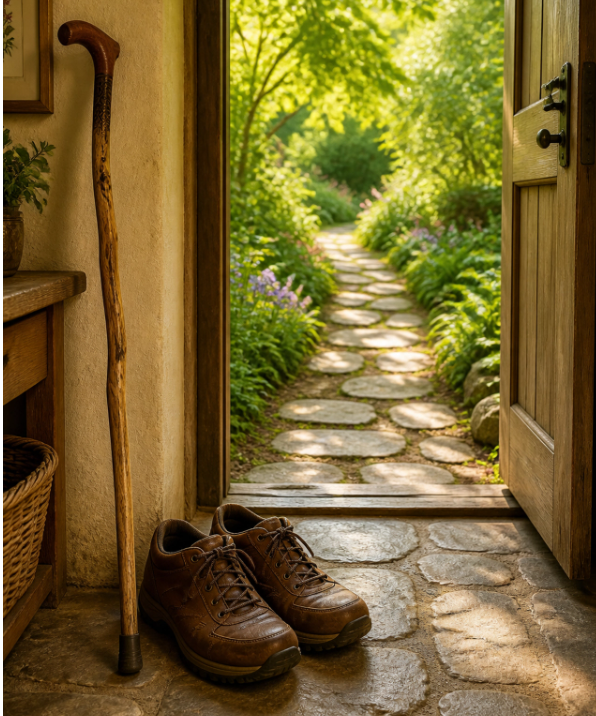
Whether it’s a morning walk down a familiar garden path or ten minutes of stretching in your favorite chair, movement is the fuel for your independence. It keeps the "machinery" of the body capable of taking you where you want to go.
Think of your walking shoes by the door not just as footwear, but as your "keys to the world." As long as you can move with stability, the world remains open to you. We focus on movement in our guided learning materials because we know that physical resilience is the bedrock of psychological freedom.
The Logistics of Connection: Creating a Check-In System
One of the most practical logistics of living alone is the "check-in." To some, this feels like an intrusion. To the prepared mind, it is a quiet safety net.
A daily text to a friend or a scheduled five-minute call with a neighbor serves two purposes. First, it ensures that if something were to happen, someone would know within 24 hours. Second, it helps you keep staying connected in an ordinary, steady way.
You might call this your "Safety Anchor." It doesn't need to be deep or emotional; it just needs to be consistent. "I’m up and having coffee" is a powerful statement of independence. It says, I am here, I am well, and I am in control.
Mapping Your Logistics: A Weekly Practice
To move from theory to action, I invite you to create your own "Logistics Map." This is a simple framework we use in our Aging Solo collection to help people visualize their day.
Identify Your Anchors: What are the three things that must happen every day for you to feel safe and healthy? (e.g., Breakfast at 8 AM, a 20-minute walk, and a 6 PM check-in with a friend).
Define Your Flexible Blocks: Where is the space for joy? Block out two hours in the afternoon for "Unscheduled Choice." This might be for reading, a hobby, or a spontaneous coffee with a neighbor.
The Weekly Review: Every Sunday afternoon, sit down with your planner and a cup of tea. Look at the week ahead. Do you have groceries? Are your prescriptions filled? Is there a social event on the horizon?
This ten-minute habit is a quiet way to care for a life well-lived. It allows you to enter Monday with a sense of peace rather than a sense of panic.
Transportation Logistics: Beyond the Driver’s Seat
If you’ve taken The Two-Week Test, you already know the logistical challenge of a world built for cars. Living fully means having a "Transportation Portfolio."
This portfolio should include at least three ways to get to the grocery store or a doctor’s appointment that don't involve you driving yourself. This might be a ride-share app, a local shuttle, or a specific friend who enjoys "errand dates." By setting these up before you need them, you ensure that a rainy day or a temporary injury doesn't ground your life.
You Are the Architect
It’s easy to feel like life is something that happens to us as the years pass. But the philosophy of Sage & Summit is different. We believe you are still the one holding the pen.
When you organize your kitchen, set up your transportation backups, and map out your routine, you aren't just "managing." You are protecting your freedom to choose. You are helping your life remain a story of your own making, filled with the things you love and the people who matter most.
Independence is not a final destination; it is a daily practice. And with the right logistics in place, it is a practice that can last a lifetime.
The days we prepare for become the days we live fully.

Sage & Summit Journal Mission:
Independence through intentional preparation.
Thought for the Week
True freedom is found in the quiet confidence that you have prepared for the journey ahead.
Sloane C. Jamison
Managing Editor, Sage & Summit
